A tree contractor credentials review should happen before a crew arrives with chainsaws, bucket trucks, or heavy equipment. Tree work often takes place near homes, vehicles, utility lines, fences, and neighboring property. The lowest estimate can become the most expensive choice if the contractor is uninsured, unprepared, or unclear about what happens when something goes wrong.
For Middle Tennessee property owners, credentials are more than paperwork. They show whether a contractor has taken the steps needed to work safely, carry responsibility for its crew, and finish the job without leaving you with debris, property damage, or an unfinished stump. A professional should be comfortable answering direct questions and providing current documentation.
Start With Insurance, Not a Verbal Promise
Many contractors say they are insured. That is a good starting point, but it is not enough to make a hiring decision. Ask for proof of current general liability insurance and review the certificate rather than relying on a business card, truck decal, or verbal assurance.
General liability coverage is intended to help protect against accidental property damage or injury to others. If a limb damages a roof, a truck, a fence, or a neighbor’s property, this coverage matters. Ask whether the policy is active, whether the name on the certificate matches the company you are hiring, and whether the work being performed is covered.
Workers’ compensation is just as important when a contractor has employees. Tree removal and pruning involve climbing, cutting, rigging, machinery, and unpredictable weight shifts. If a worker is hurt on your property, you do not want uncertainty about who is responsible for the medical costs and lost wages. A legitimate contractor should be able to explain whether it carries workers’ compensation coverage or operates under a valid exemption where applicable.
Do not assume that a homeowner’s insurance policy will cover a contractor’s mistake. Policies vary, and disputes can take time. Verifying coverage before work starts is a practical way to reduce risk.
Understand What “Licensed” Means for Tree Work
Homeowners often ask whether a tree company is licensed and insured. Insurance is straightforward to verify. Licensing can be more complicated because requirements may vary by city, county, business type, and the scope of work.
A business license or registration shows that the company is operating as a legitimate business, but it does not automatically prove skill in pruning, removals, crane work, or land clearing. Likewise, a contractor license may be required for certain construction-related work without being a universal credential for every tree service.
That does not mean licensing is unimportant. It means you should ask a more specific question: What local permits, registrations, or approvals apply to this job, and who will handle them? This is especially relevant for commercial properties, HOA communities, development sites, and work involving public rights-of-way.
If a tree is close to power lines, stop and ask more questions. Private tree contractors should not perform work inside restricted electrical clearances unless they are properly qualified and authorized to do so. The utility company may need to be involved. A responsible contractor will explain the boundary instead of taking a dangerous shortcut.
Tree Contractor Credentials Review: Training Counts
Tree work is not simply cutting branches until a tree looks smaller. Poor cuts can injure a tree, create weak regrowth, or remove too much canopy. Poor removal planning can put people and structures in harm’s way.
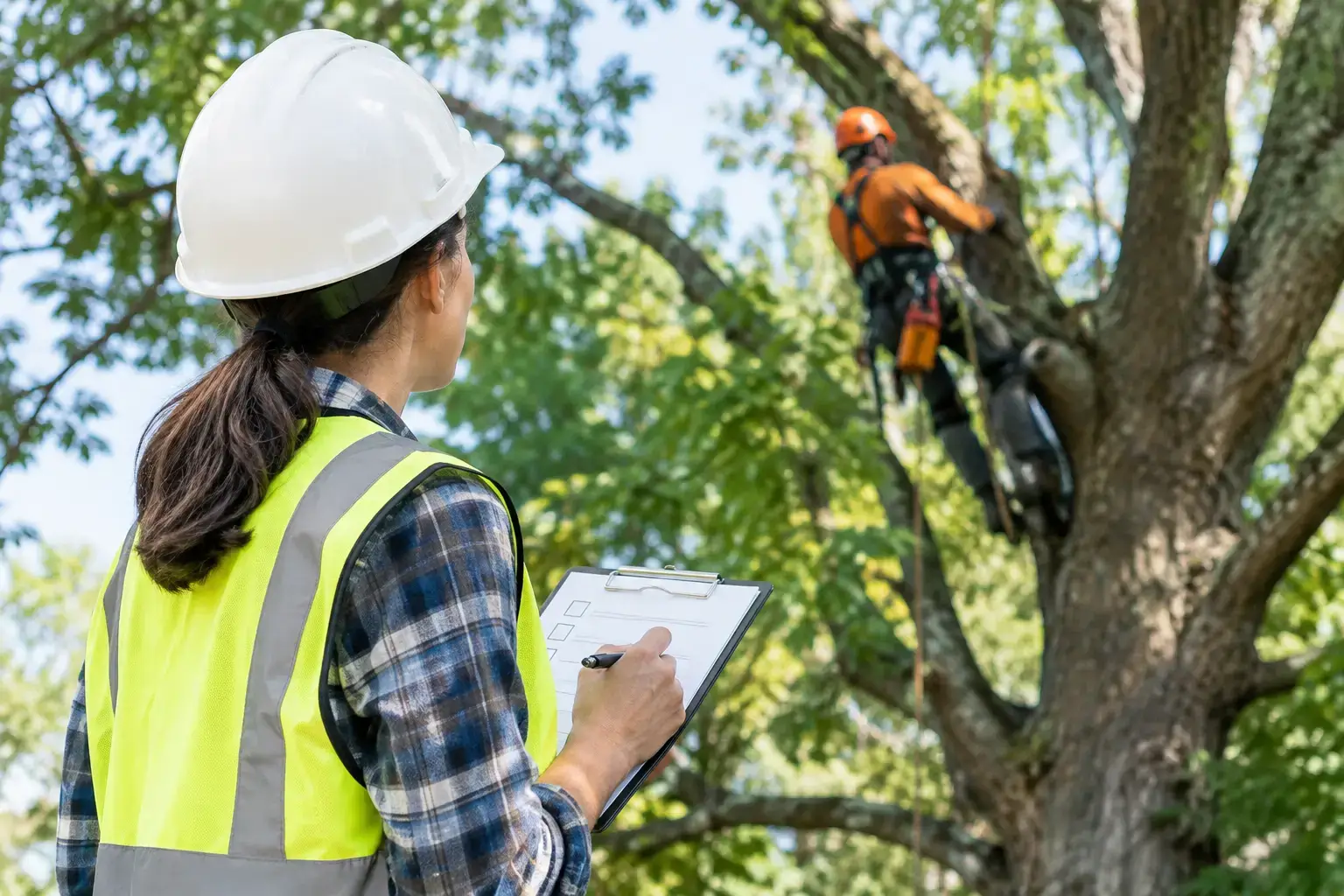
Ask who will assess the tree and who will lead the crew. Experience matters, particularly with mature hardwoods, storm-damaged trees, leaning trunks, decay, tight access, and removals near buildings. A contractor should be able to explain the work plan in plain language: where equipment will be placed, how limbs will be lowered, what areas need to stay clear, and whether the tree can be safely climbed or requires specialized equipment.
Professional credentials may include ISA Certified Arborist status, training in aerial rescue, chainsaw safety, rigging, or equipment operation. These qualifications can be valuable, but they should be considered alongside real field experience and sound job planning. An arborist credential is useful when you need a tree-health assessment, pruning recommendations, or risk evaluation. For a large removal, the crew’s safety process, equipment capability, and insurance are equally important.
There is a trade-off here. A small crew may have lower overhead and offer a lower price for a straightforward pruning job. A larger, well-equipped company may be better suited for hazardous removals, commercial maintenance, acreage clearing, or work requiring traffic control and coordinated cleanup. Match the contractor’s capabilities to the job rather than choosing by price alone.
Look for a Clear Safety Plan
A safe tree crew does not need to make a show of safety, but its process should be visible. Before work begins, the crew should inspect the tree, the drop zone, nearby structures, overhead lines, access routes, and ground conditions. They should identify who is working aloft, who is operating equipment, and where homeowners, children, pets, and visitors need to stay.
Weather can change the plan. High winds, lightning, saturated ground, and icy conditions can make a removal unsafe even when the tree itself is already damaged. During storm cleanup, urgency is understandable, but rushing is not a safety plan. A dependable contractor will tell you when conditions require a delay or a different approach.
Equipment also deserves a closer look. The right equipment can reduce the need to drag heavy limbs across a lawn, squeeze oversized machinery through a narrow gate, or drop large wood near a structure. However, bigger equipment is not always better. On a small residential lot, careful access planning and ground protection can matter more than the size of the truck.
Get the Scope of Work in Writing
Credentials tell you who may be qualified to do the work. The written estimate tells you what they have agreed to do. Both are necessary.
A complete estimate should identify the trees or areas being addressed and state whether the work includes removal, pruning, stump grinding, root removal, hauling, wood disposal, and final cleanup. It should also clarify whether the contractor will leave firewood, chips, or logs on site if requested.
Ask what is excluded. For example, stump grinding removes the visible stump and may grind surface roots, but it does not always remove every root across a yard. Tree removal may not include restoring turf disturbed by equipment. Land clearing may require separate arrangements for grading, erosion control, or construction preparation. Clear expectations prevent frustration after the crew leaves.
Before approving a project, request these items in writing or as current documentation:
- Proof of general liability insurance
- Workers’ compensation information or applicable exemption details
- A written scope of work and cleanup plan
- Permit responsibility, when permits apply
- Payment terms and any conditions that could change the price
Be cautious if a contractor demands full payment before beginning work, refuses to provide documentation, pressures you to decide immediately, or offers to handle permits without explaining the process. Those are not automatic proof of a bad business, but they are reasons to slow down and ask for clarity.
Check Reputation the Right Way
Reviews and referrals are useful because they reveal patterns that a certificate cannot. Look beyond the overall star rating. Read for details about punctuality, communication, cleanup, respect for property, response after storms, and whether the final bill matched the estimate.
A few negative reviews do not automatically disqualify a contractor. Even good companies occasionally face scheduling problems, weather delays, or misunderstandings. What matters is whether the feedback shows a repeated issue and whether the business responds professionally when a problem occurs.
For commercial managers and HOA boards, ask for examples of similar work. A company that handles a single backyard pruning project well may not be the right fit for recurring maintenance across an apartment community, retail center, or large tract. The contractor should have the crew capacity, equipment, scheduling discipline, and documentation needed for the property.
Ask Who Is Actually Doing the Work
Some companies sell the job and then subcontract all or part of it. Subcontracting is not automatically a problem, especially for specialized services. But you deserve to know who will be on site and whose insurance applies.
Ask whether the estimate is being completed by the same company that will perform the work. If subcontractors are involved, ask whether they carry their own insurance and whether the primary contractor remains responsible for cleanup, damage, scheduling, and communication. A clear answer protects everyone from finger-pointing if an issue arises.
Credentials Are Part of Respecting Your Property
The best contractor credentials review combines documents with common sense. Current insurance, relevant training, a clear estimate, safe work practices, capable equipment, and a proven local reputation all point in the same direction: a crew that treats the work seriously.
Before you approve tree removal, trimming, stump grinding, or land clearing, take the extra few minutes to ask for proof, read the estimate, and understand the work plan. The right contractor will respect those questions, because protecting your property starts well before the first cut.