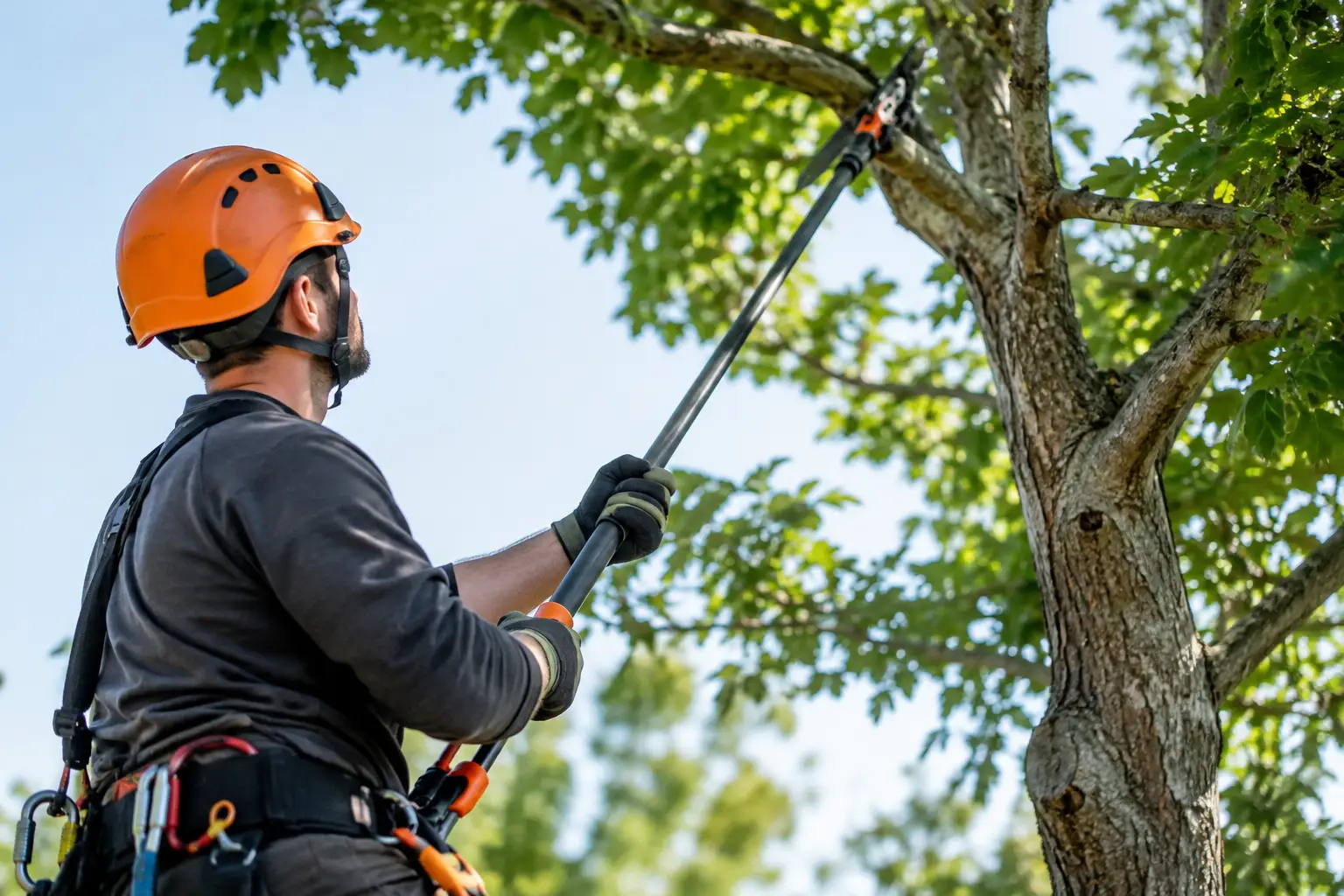
A mature oak hanging over a driveway, a maple pressing toward a roofline, or a storm-stressed tree with long, heavy limbs can make a property owner feel like the only answer is removal. Often, it is not. Crown reduction is a careful pruning method that reduces a tree’s overall height or spread while preserving its natural form, structure, and ability to recover.
Done correctly, this work can lower the force placed on vulnerable limbs, create more clearance around buildings, and help retain a valuable mature tree. Done poorly, it can leave a tree weakened, disfigured, and more likely to fail later. The difference comes down to the tree, the reason for pruning, and the skill of the crew doing the work.
What Is Crown Reduction?
Crown reduction reduces the size of a tree’s canopy by selectively cutting branches back to suitable lateral branches. Rather than cutting a limb at an arbitrary point, the goal is to redirect future growth to a smaller, healthy branch that can take over the limb’s role.
A proper reduction usually focuses on the outer portions of selected branches. It may reduce a tree’s height, its side spread, or the end weight on long limbs. The tree still looks like itself when the work is complete. Its canopy should not look flat across the top, stripped out, or chopped into a shape that does not match its natural growth habit.
For many Middle Tennessee properties, crown reduction is most useful on mature trees near homes, parking areas, fences, utility lines, and high-use outdoor spaces. It can also be appropriate when a tree has structural concerns but remains healthy enough to keep.
Crown Reduction Is Not Tree Topping
Tree topping removes large sections of the upper canopy or cuts branches back to stubs. It may appear to be a quick way to make a tree shorter, but it is not a sound long-term pruning practice. Large topping cuts create wounds that are slow to close, expose the tree to decay, and often trigger fast-growing shoots with weak attachment points.
Those shoots can become a bigger problem than the original branches. They grow quickly, are often poorly connected to the remaining wood, and can create future breakage hazards. Topping also removes a large amount of leaf area at once, which limits the tree’s ability to produce energy and respond to stress.
Crown reduction takes more planning because each cut must have a purpose. A trained crew considers branch size, growth direction, existing defects, decay, canopy balance, and the amount of foliage being removed. There are times when removal is safer than repeated heavy pruning, especially if a tree is seriously decayed, unstable, or already declining. An honest assessment should make that clear before work begins.
When a Tree May Need Crown Reduction
The best reason to reduce a canopy is a specific concern, not simply a desire to make a healthy tree smaller. A large tree can be a major asset to a property, providing shade, privacy, and curb appeal. Pruning should address a real need while removing as little living material as practical.
One common reason is excessive end weight. Long, overextended limbs can place a great deal of leverage on branch unions, especially after heavy rain, wet snow, or high winds. Selective reduction can shorten those limbs and lessen the chance of breakage without removing the entire branch.
Clearance is another reason. A branch may be extending over a roof, crowding a chimney, reaching toward a structure, or interfering with a driveway and regular vehicle access. Reducing selected limbs can create space while maintaining a more natural canopy than aggressive cutting.
A tree with previous storm damage may also benefit from careful reduction. After a limb breaks, the remaining canopy can become unbalanced or leave other limbs carrying more weight than before. Proper pruning can address torn wood, reduce stress on damaged leaders, and improve the tree’s overall structure where possible.
Crown reduction is sometimes used when a tree has outgrown its location. That situation requires judgment. If a tree needs major reduction every few years just to stay away from a house or power line, removal and replacement with a better-suited species may be the more responsible long-term choice. Repeatedly forcing a large tree into a small space can create ongoing expense and risk.
How Much Can Be Removed Safely?
There is no single percentage that works for every tree. Species, age, health, season, recent weather, disease pressure, root condition, and the tree’s history all matter. A vigorous, healthy tree may tolerate moderate selective pruning, while a stressed or declining tree may not tolerate much canopy loss at all.
As a general rule, good pruning avoids taking more live canopy than necessary in one visit. Large reductions can shock the tree, encourage weak regrowth, and expose previously shaded bark to sun damage. Mature trees deserve an especially conservative approach because they do not recover as quickly as young trees.
The size of each cut matters, too. Larger cuts create larger wounds, and they increase the chance of decay entering the wood. When possible, a reduction cut should be made back to a lateral branch substantial enough to support continued growth. This keeps the branch structure more stable and helps the tree direct energy where it is needed.
That is why a crew should inspect the tree before giving a recommendation. From the ground, a tree may look like it only needs a few branches shortened. Up close, there may be cracks, cavities, included bark, deadwood, fungal growth, or storm damage that changes the right course of action.
Timing Matters, but Safety Comes First
Many pruning projects are best handled during a tree’s dormant season, when foliage is off deciduous trees and crews can see branch structure more clearly. Winter pruning can also be less disruptive to some trees and landscapes. However, the ideal time varies by species and by the condition of the tree.
When a limb is damaged, hanging, or creating an immediate hazard, waiting for the perfect season is not the right answer. Safety work should be handled promptly. Storms in Rutherford, Davidson, and Williamson counties can leave heavy limbs over homes, roads, fences, and common areas, and those situations need a professional evaluation as soon as conditions are safe.
Avoid treating every overgrown tree as an emergency. A well-planned pruning visit gives the crew time to assess structure, determine appropriate cuts, protect the surrounding property, and complete thorough cleanup. That planning is part of safe tree care.
What Professional Crown Reduction Looks Like
A professional crew starts with the tree and the site. They look at the canopy, trunk, root zone, targets below the tree, access for equipment, and nearby structures. They should explain whether reduction is appropriate and be straightforward if the tree is a removal candidate instead.
During the work, the crew should use controlled cuts and proper rigging when branches are over roofs, driveways, landscaping, or other sensitive areas. The goal is not simply to get limbs on the ground. It is to remove or reduce them without damaging the property, tearing bark, or creating unnecessary wounds on the tree.
Cleanup matters as much as the cutting. Branches, brush, sawdust, and debris should not be left for the property owner to handle. On commercial sites and HOA properties, clean work areas also help reduce trip hazards and keep entrances, parking areas, and sidewalks presentable.
Be cautious of anyone who recommends topping, promises to make a tree safe with a single drastic cut, or cannot clearly explain what will be removed and why. Tree work involves real risk to people, buildings, and the tree itself. Licensed and insured professionals with the right equipment are worth calling when large limbs or difficult access are involved.
Protect the Tree and the Property
Crown reduction can be a practical way to manage a mature tree without losing the shade and character it brings to a property. It is not a shortcut, and it is not the answer for every tree. The right approach may be light pruning, selective limb removal, structural cabling in limited cases, or complete removal when the risk is too high.
For homeowners, HOAs, and commercial property managers, the best next step is a site-specific evaluation before the next storm exposes a problem. Men in Green provides clear estimates and safety-focused tree assessments for properties across Middle Tennessee. A well-planned reduction today can help keep a good tree in place while giving the people and structures below it more room to breathe.