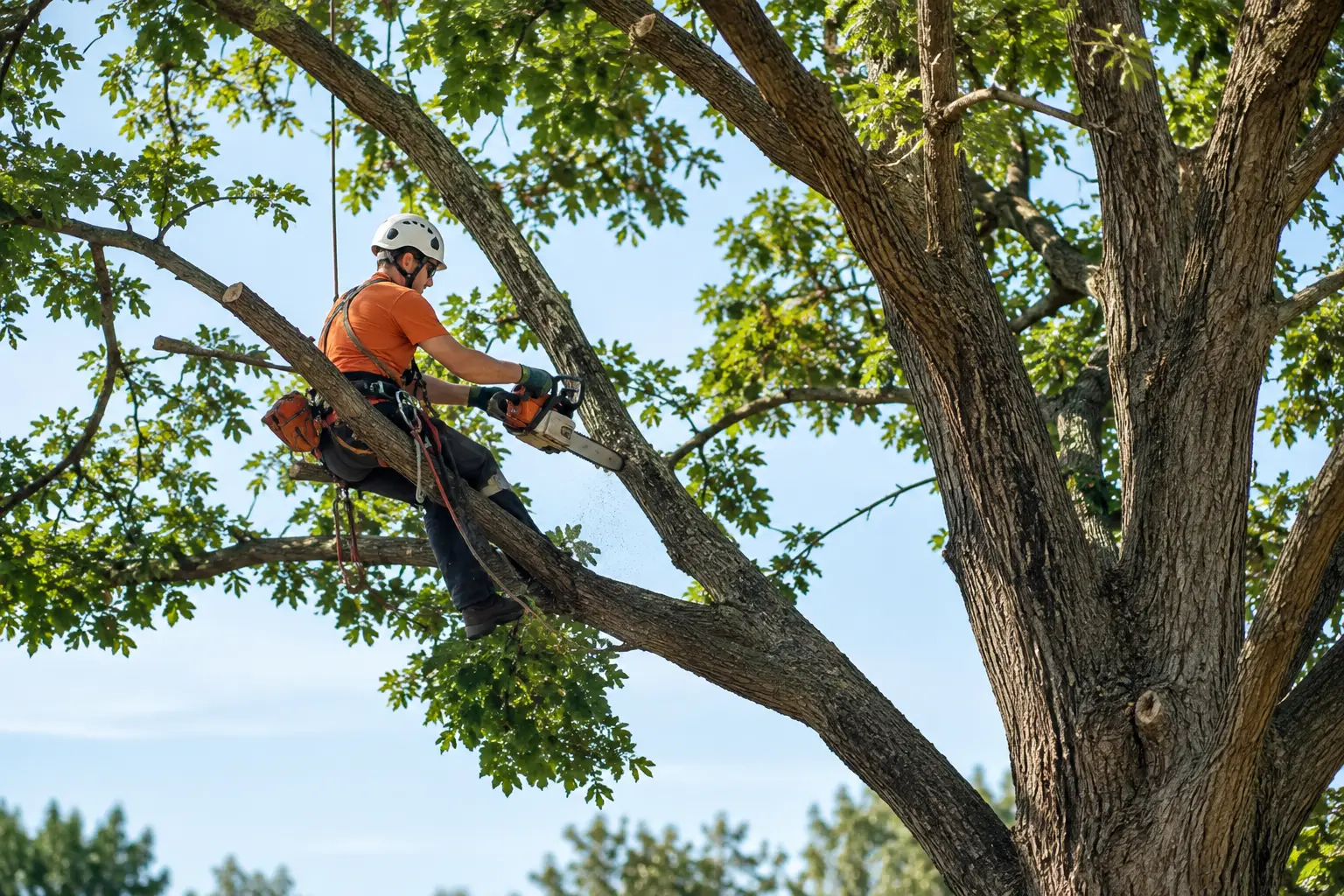
A mature oak can look strong right up until a heavy, overextended limb fails over a driveway, roof, fence, or sidewalk. Canopy weight reduction is a targeted pruning service that removes selected branches to reduce stress in the crown while preserving the tree’s natural structure. Done correctly, it can help a valuable tree handle wind, rain, and seasonal growth with less risk.
For homeowners, HOAs, and commercial property managers in Middle Tennessee, this work is often about prevention. Our storms can bring saturated soil, high winds, and sudden limb failures. A professional assessment helps identify where a tree is carrying more weight than its structure can safely support.
What Canopy Weight Reduction Actually Does
Canopy weight reduction is not the same as cutting a tree back hard or making it look smaller from the ground. A qualified crew selectively shortens long, heavy limbs by pruning them back to a healthy lateral branch that can continue supporting growth. This is commonly called reduction pruning.
The goal is to take leverage off the end of a limb. Think of a long branch as a lever: the farther its weight extends from the trunk or main union, the more force is placed on the connection point during wind, ice, or heavy rain. Reducing length and end weight can lessen that force without stripping the tree of the foliage it needs.
Proper reduction pruning retains the tree’s shape. It focuses on individual limbs that are overextended, cracked, poorly attached, rubbing against other branches, or reaching too far over a high-value target such as a home, parking area, play space, or service entrance.
When a Tree May Need Weight Reduction
Not every large tree needs pruning, and a full-looking canopy is not automatically a hazardous one. Mature trees need enough leaf area to produce energy, recover from stress, and remain healthy. The question is whether specific limbs are creating a structural concern.
Weight reduction may be appropriate when a limb has grown far beyond its main support, especially if it extends over a structure or frequently occupied area. It can also help when several branches are competing in the same section of the canopy, causing included bark or crowded branch unions. Included bark is bark trapped between stems or limbs, and it can be a warning sign that the connection is weaker than it appears.
Other reasons to schedule an evaluation include visible cracks, old storm damage, hanging or broken limbs, branches sagging over a roof, and limbs contacting utility lines. If a branch has already failed nearby, it is worth checking the rest of the tree rather than assuming the problem was isolated.
Trees growing at the edge of a wooded lot can need special attention after land clearing or construction. Once surrounding trees are removed, a tree that was previously sheltered may be exposed to stronger winds. Its canopy and root system may need time to adjust. Selective pruning can sometimes reduce the wind load, but the right approach depends on the tree’s species, condition, root health, and location.
Why Topping Is Not Canopy Weight Reduction
A common mistake is to solve an overgrown-tree concern by topping it. Topping means cutting major branches back to stubs or cutting across the crown without regard for proper branch connections. It may make the tree shorter quickly, but it can create larger problems.
Large stubs are slow to seal over and can become entry points for decay. The tree often responds by producing fast-growing shoots below the cuts. Those new shoots are typically weakly attached and can become a future failure risk. Topping also removes a large amount of foliage at once, placing the tree under significant stress.
Canopy weight reduction uses deliberate cuts at appropriate lateral branches instead. It is slower, more technical work, and it may not create the dramatic change some property owners expect. That is often a good sign. The best pruning work improves safety while avoiding unnecessary damage to a living tree.
The Right Amount Depends on the Tree
There is no safe percentage that applies to every tree. The amount of canopy that can be reduced depends on age, species, health, prior pruning, decay, root disturbance, and the reason for the work. An old oak with a large cavity needs a different plan than a healthy young maple with a few overextended limbs.
In many cases, less is better. A crew may reduce weight on just one or two problem limbs, remove deadwood, and improve clearance over a roof or drive. For a tree with broader structural issues, the work may need to happen in stages over more than one season. Gradual pruning gives the tree time to respond and helps avoid removing too much live canopy at once.
There are also times when pruning is not the honest answer. If a trunk has significant decay, a major split is progressing, the root system has been compromised, or the tree is leaning toward a home with no reasonable way to reduce the risk, removal may be the safer recommendation. A reputable tree company should explain that difference clearly, not sell pruning as a cure for every problem.
What a Professional Evaluation Should Include
Before any pruning begins, the crew should look beyond the branch that caught your attention. Tree risk is a combination of the likelihood of failure and what could be damaged if it fails.
A thorough assessment considers the trunk, root flare, major branch unions, canopy condition, previous wounds, nearby structures, access for equipment, and the area beneath the tree. Dead branches are important, but so are live limbs with poor attachments or excessive end weight. Soil conditions matter too. After prolonged rain, saturated ground can reduce root support, particularly around trees with shallow or damaged root systems.
For commercial sites and HOA communities, the inspection should also consider pedestrian routes, parking spaces, signage, lighting, and scheduled events. A limb over an unused corner of a large lot presents a different level of concern than the same limb over a main entryway.
Timing Pruning Around Middle Tennessee Weather
Tree work can be scheduled throughout much of the year, but timing can affect access, cleanup, and how the tree responds. Dormant-season pruning is often useful because crews can better see branch structure after leaves drop. It can also be a practical time to address concerns before spring storms and new growth.
That said, hazardous limbs should not wait for an ideal calendar date. A cracked branch over a roof or sidewalk needs prompt attention whether it is January or July. Storm cleanup may also reveal damage that was hidden inside the canopy.
Some tree species have timing considerations related to disease pressure, sap flow, flowering, or nesting wildlife. A professional can recommend a schedule that balances the tree’s needs with the safety concern on your property.
Protecting the Property During the Work
Good pruning is about more than making proper cuts. It also requires a clear plan for protecting the property below. Mature-tree work may involve ropes, aerial equipment, controlled lowering of limbs, and careful placement of trucks and chippers. The access route, underground utilities, landscaping, fences, and nearby vehicles should all be discussed before work starts.
Cleanup matters as well. Brush, sawdust, and wood sections should not be left scattered around a yard, parking area, or common space. For many property owners, the job is not finished until the area is cleared and safe to use again.
Men in Green provides tree assessments and pruning services for property owners across Middle Tennessee, with owner involvement, professional equipment, and a focus on leaving the site clean. If a limb is showing cracks, growing over a structure, or simply carrying more weight than it should, getting an honest assessment before the next major storm is a practical step toward protecting both the tree and the property around it.